
When the prophet Jacob counseled us to “think of your brethren like unto yourselves, and be familiar with all and free with your substance, that they may be rich like unto you,” this has to be a classic example.
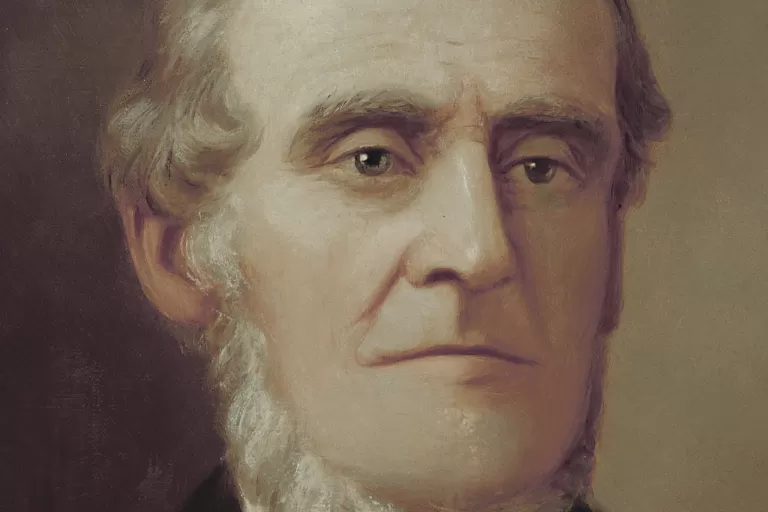
He was a man raised up for a singular purpose, called and chosen to assist in the bringing forth of the Book of Mormon. Martin Harris came from a family of English Quakers who emigrated to Palmyra, New York at the end of the 18th century. They settled on 600 acres just north of the Palmyra town site, and turned it into some of the best farmland in the area.
Martin married his first cousin Lucy Harris, and they raised a family. By 1825 their marriage was in sufficient difficulty that they legally divided their property, and moved into separate households, though they continued amicable association as far as possible.
Joseph Smith received a revelation through the Urim and Thummim that Martin Harris was to be the man to assist in bringing forth the Book of Mormon. Hence in the summer of 1829 when the Book of Mormon was about to be printed, 5,000 copies of the Book of Mormon for the price of $3,000, it was Martin Harris who stepped forward and offered his farm as collateral for the printing. It was a fortune, and no one but Martin had the faith and means to support such an undertaking.
What must have gone through his mind on August 25, 1829 when Martin signed the agreement with Egbert B. Grandin that Grandin would print the Book of Mormon, and if book sales did not sufficiently compensate Grandin, Martin would sell his farm to pay the debt?
Martin had built one of the most coveted farms in all of Palmyra. He was a prosperous and well-respected member of the community. And now all of that was on the line - His farm was mortgaged to Grandin, and his reputation hung on Joseph Smith and the Book of Mormon. Of course when the Book came off the presses, book sales would surely square the debt and Martin would keep his farm.
Then March 1830, the first copies of the Book of Mormon came forth, and with his arms loaded with books, Martin went throughout the community soliciting sales. But the angry hard-hearted citizens of Palmyra held true to their threatened boycott, and the books did not sell. It was becoming evident to Martin that this endeavor would cost him his life’s work.
Then, finally, February 1831, the agreement with Grandin came due, and Martin sold his farm to a family friend, Thomas Lakey, for $3,000.
Now history has not been particularly kind to Martin Harris. But say whatever you like, he willingly paid for the Book of Mormon, and by that sacrifice obtained a faith in the book that lasted the rest of his life. Joseph the Seer translated it. Oliver Cowdery wrote it down, but what of their work if no one could read it? Think for just a moment of the good those first 5,000 copies accomplished. They brought an entire generation to the Savior and his restored Gospel. Just one of those books today is worth more than all that Martin originally gave for the lot.
Though Martin could not have known it at the time, he gave his land for a legacy, and his reputation among men for another in heaven. As long the Book of Mormon continues to bring men to worship the risen Christ, the name of Martin Harris, special witness, will be held in eternal respect, honor, and gratitude.
Story Credits
Glenn Rawson – March 2016
Music: “Martin Harris & Jacob” (edited) – Christina K. Monson
Song: “Because I Have Been Given Much” – Kenneth Cope