
It was May of 1848 when Elisha Groves and his wife Lucy set out from the Missouri River in their journey to the Valley of the Great Salt Lake. They were among nearly 2000 people traveling in one large wagon company.
Passing through Indian country they had been told for their own safety not to stop their wagons, but to keep the train unbroken. One day somewhere in Nebraska territory, Lucy attempted to climb out of the slow-moving wagon. Weak from having given birth just days before, she slipped and fell before the wheel. It passed over her body breaking three ribs in the process. Her husband, walking nearby, quickly grabbed her and tried to pull her away from the wagon, which was still moving, but the back axle passed over her, now breaking one of her legs.
The captain of the company came quickly. He set her leg and gave her a blessing, “assuring her that she would reach Salt Lake in good condition.”
A large bed was set up in the wagon box for Lucy, and for the next several days she was confined as the company continued to move. Her leg was mending well, and it was expected that she would be up soon. Then about nine days after the incident, Lucy’s daughter accidentally tripped over her mother’s leg, breaking it again!
This time it was much worse. As the wagon jolted and bounced along the trail, the pain was agonizing and unbearable! Lucy finally pleaded with her husband to stop the wagon. Seeing the Groves wagon pull out of the line, the Captain stopped the entire train and rode up to investigate.
With tears coursing down her cheeks, Lucy explained to the captain the situation, and urged that the company go on without them. The captain replied that he would do no such thing. He would not leave any of his people behind. He ordered the entire company to make camp for the night, and then instructed some of his men to saw the legs off of Lucy’s four-poster bed so that nothing remained but the laced frame. They then fastened the frame to the wagon bows overhead, effectively forming a free-swinging hammock. This done, he then blessed Lucy again promising her that she would live for many years.
For the next several days this busy captain rode beside Lucy’s wagon to make sure that she had no further trouble.
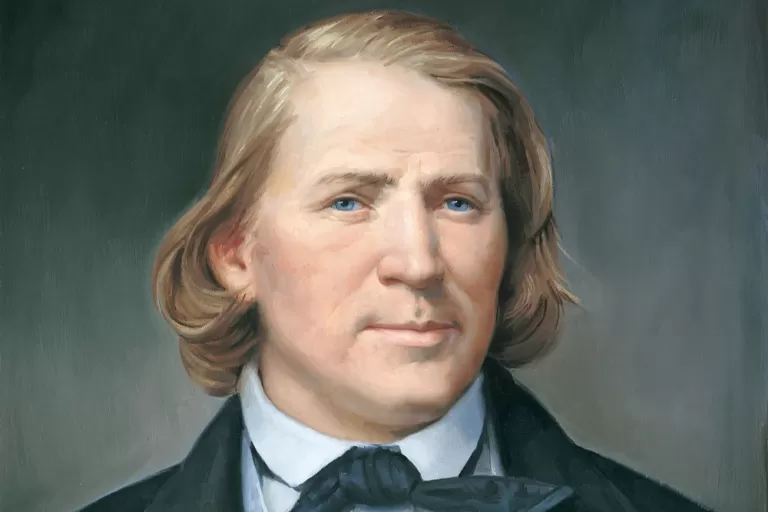
Lucy’s grandson later wrote of this event. He said, "With this gentle kind manner, [Brigham Young, the wagon master] won the love of Lucy and her posterity forever."
Story Credits
Glenn Rawson - April 2012
Music: Come, Come Ye Saints (edited) - Sam Cardon
Song: Arrival in the Valley - Envoy
Source: American Moses, by Leonard Arrington
Painting: Brigham Young, American's Moses by Kenneth Corbett